

It isn't about where you're from,
It's where you're going that counts!
-ella fitzgerald-
African Studies and social justice Dept
The African Studies & Social Justice Department is dedicated to developing informed, thoughtful, and engaged students through the study of African civilizations, global systems, governance, resistance, cultural expression, and social transformation. Students learn how societies are built, how power operates, how communities respond to challenges, and how individuals and institutions create change.

Students explore African history, political systems, cultural traditions, social movements, constitutional principles, civic participation, and comparative global studies. Through historical analysis, research, discussion, media production, artistic expression, and project-based learning, students develop critical thinking, communication, leadership, and civic responsibility while preparing for active participation in a global society.

Course description
The African Studies & Social Justice Pathway at The XyayX Institute is available to students from Kindergarten through Grade 12 through a carefully structured, vertically aligned curriculum. Students engage with four recurring domains: Institutional Sovereignty & Governance, Forensic Systems Analysis, Architecture of Resistance & Cultural Expression, and Revolutionary Foundations & Global Independence. These domains are revisited at every grade level with increasing depth, complexity, and analytical rigor.
As students advance through the program, instruction transitions from identity development and cultural awareness to systems analysis, historical investigation, comparative evaluation, philosophical reasoning, and independent research.
WHY AFRICAN STUDIES & SOCIAL JUSTICE MATTERS
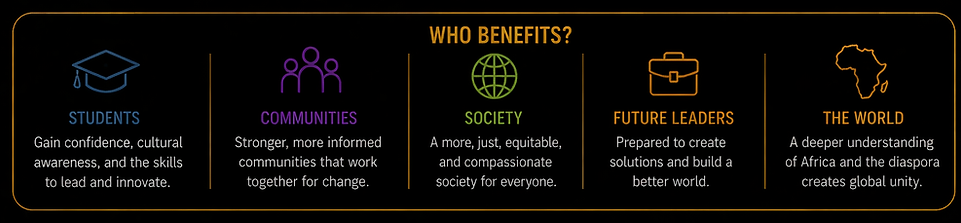
Understanding history helps students understand themselves, their communities, and the world around them. Through the study of African history, culture, achievements, and struggles, students gain a deeper appreciation for the contributions of African people throughout history while examining the challenges and injustices that have impacted Black communities.
At The XyayX Institute, students learn to think critically about social issues, recognize injustice, and use their knowledge, voice, and leadership to create positive change. By studying the past, students become empowered to help build a stronger, more informed, and more equitable future for their communities and society as a whole.

OUR FOUR CORE DOMAINS
The African Studies & Social Justice curriculum is organized around four core domains that guide student learning from Kindergarten through Grade 12. These domains help students examine African civilizations, systems of power, cultural expression, resistance movements, and the ongoing pursuit of justice and self-determination. Together, they provide students with a deeper understanding of history, identity, leadership, civic engagement, and the role individuals play in creating positive change within their communities and the world.
Domain 1: Institutional Sovereignty & Governance
Focus: Examining how African civilizations developed systems of governance, economics, science, culture, and leadership that sustained complex societies and influenced global development.
Domain 2: Forensic Systems Analysis
Focus: Investigating colonization, systemic inequality, economic exploitation, legal structures, and global systems of power through historical and comparative analysis.
Domain 3: Architecture of Resistance & Cultural Expression
Focus: Exploring how African and African Diaspora communities responded to oppression through resistance, adaptation, institution-building, artistic expression, and cultural preservation.
Domain 4: Revolutionary Foundations & Global Independence
Focus: Analyzing political thought, liberation movements, Pan-Africanism, self-determination, and the intellectual foundations of social transformation and global Black identity.
VERTICAL ALIGNMENT ACROSS GRADE LEVELS

The African Studies & Social Justice curriculum is vertically aligned from Kindergarten through Grade 12, ensuring that students revisit the same four core domains at increasing levels of depth and complexity throughout their educational journey. In the early grades, students develop foundational knowledge of identity, culture, community, leadership, and historical awareness.
As students progress through elementary and middle school, they begin analyzing civilizations, institutions, systems of power, resistance movements, and social change. At the high school level, students engage in advanced research, historical analysis, civic inquiry, policy evaluation, and critical discussions of local, national, and global issues. This progression allows students to build knowledge year after year while developing the analytical, communication, and leadership skills necessary to become informed scholars and engaged citizens.
FOUNDATIONAL YEARS
Grades K–3: Explorer Level
Students develop awareness of identity, culture, leadership, and community through storytelling, music, visual art, and guided discussion. Students are introduced to African civilizations, important historical figures, cultural traditions, fairness, responsibility, and cooperation.
Activities focus on helping students understand that communities are built by people working together and that leadership, culture, and problem-solving play important roles in society. Students communicate their understanding through drawing, storytelling, movement, and simple written responses.
Grades 4–5: Builder Level
Students begin exploring how societies function through governance systems, trade networks, leadership structures, and cultural institutions. Instruction emphasizes patterns, cause-and-effect relationships, and how systems influence people's lives.
Students examine African civilizations, early global systems, leadership strategies, and forms of resistance while developing structured reading, writing, discussion, and presentation skills. Creative expression remains central through visual projects, storytelling, and media interpretation.


Grades 6–8: Analyst Level
Grades 6–8: Analyst Level
Middle school students transition into formal analysis of historical and social systems. Students examine governance structures, colonization, resistance movements, economic systems, political institutions, and social transformation.
Students engage with primary and secondary sources, compare systems across regions and time periods, evaluate outcomes, and develop evidence-based arguments. Through written, visual, and digital projects, students connect historical systems to contemporary social issues.
ADVANCED YEARS
Grades 9–10: Scholar Level
High school students engage in formal study of governance systems, colonization, structural inequality, and comparative global systems. Students analyze political, legal, economic, and social institutions while evaluating how historical systems continue to shape modern conditions.
Coursework emphasizes primary source analysis, structured argumentation, comparative systems evaluation, and sustained analytical writing. Students produce research projects and media-based work that demonstrate independent reasoning and critical analysis.
Grades 11–12: Researcher Level
Advanced students engage in independent research, philosophical reasoning, political theory, resistance studies, and system transformation. Students examine competing frameworks for liberation, self-determination, governance, and social change while evaluating their effectiveness across historical and contemporary contexts.
Through advanced research papers, presentations, debates, documentaries, policy analyses, and creative projects, students demonstrate scholarly independence and the ability to connect historical systems to modern challenges.

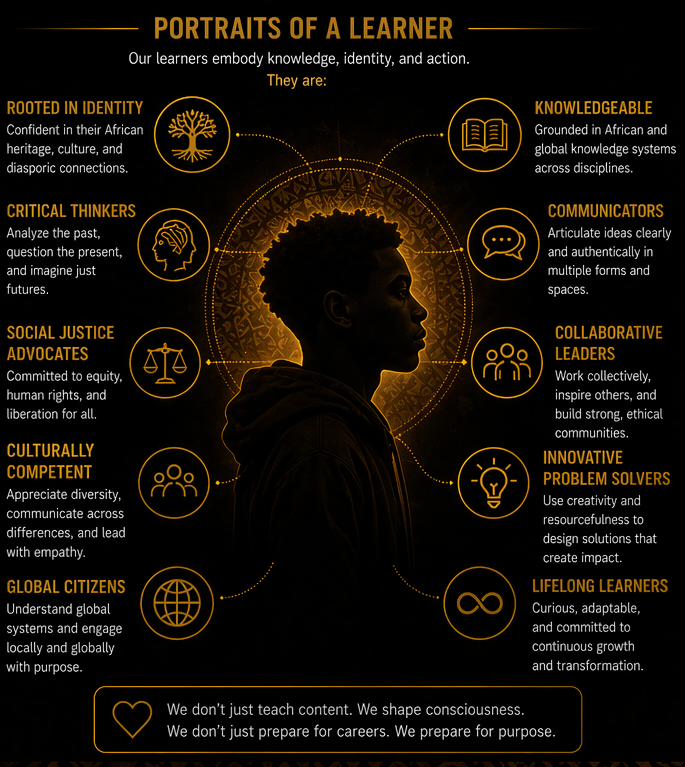
PORTRAIT OF A LEARNER
Students in the African Studies & Social Justice Program develop into informed, thoughtful, and socially conscious learners who understand the importance of history, culture, civic engagement, and community leadership. Through the study of African civilizations, systems of governance, resistance movements, cultural expression, and social transformation, students learn to think critically, analyze complex issues, communicate effectively, and advocate responsibly for themselves and others.
As students progress through the program, they grow from explorers of identity and culture into researchers, analysts, and emerging leaders capable of evaluating systems, examining multiple perspectives, and proposing solutions to real-world challenges. Graduates of the program leave with a strong sense of identity, historical awareness, civic responsibility, and a commitment to using their knowledge and voice to contribute positively to their communities and society.